Showing posts with label indie. Show all posts
Sunday, December 19, 2010
Playlist: Winter's Bone
This is the type of film that absorbs you into its world, not through bang wow CGI, but through an undeniable authenticity.
Not that I have any first-hand knowledge of the rural poverty depicted here. How many indie moviegoers do? How many of the judges who awarded it the Grand Jury Prize at this year's Sundance jetted home to a meth-ravaged Ozarks town? That's not how art works. I wasn't at Guernica, Dresden, or, despite rumor, Folsom. And I thankfully don't need to travel back in time to appreciate the art inspired by those events and places.
Good art should seep into a person and settle into all those little emotional cracks we have in our psyche. Winter's Bone is good art. It doesn't hit you over the head with liberal guilt or stroke you with hollow conservative apathy. When I said it was authentic I meant that it's just the story it is with no cheap theatrics or embarrassing grasps at, gag, a message. It's not the best film I've seen this year, though it is one of the most memorable. It's too small to worry about the baggage of greatness. It was made to tell a specific story and it achieved that. (That story, btw, is about a teenage girl struggling to raise her two younger siblings who has to find her bail-jumping father in order not to lose the house and land he put up as collateral. No, it's not a comedy.)
Star Jennifer Lawrence, however, is about to get big. She has earned a Golden Globe nomination and will hopefully follow that with an Oscar nod. I don't think she can get enough praise for her performance. I was surprised to read that she's going to be Mystique in the new X-Men movie, but then I saw her here and understood. While Lawrence carries the film, I need to mention another terrific turn by an unusually menacing John Hawkes (Deadwood, Eastbound & Down) as her uncle.
Bonus: there's an unintentional easter egg for Twin Peaks fans: an almost unrecognizable Sheryl Lee. You're all getting older, aren't you?
Friday, October 15, 2010
Playlist Triple Feature
The term "mumblecore" was coined by sound mixer Eric Masunaga, but it was his director, Andrew Bujalski, who brought it to life. Though "life" might not be the best word choice for a filmmaker of such purposefully anti-plot movies. Three, to be exact.
The movie usually credited with launching the movement was Bujalski's 2002 debut, Funny Ha Ha. As if you had to guess, it's the story of recent college grad Marnie trying to find her place in adulthood. The movie drifts along with her, its structure bringing to mind Richard Linklater's 1991 Slacker, itself credited with kicking off the indie boom of the previous decade. While I can't deny Slacker's influence--Kevin Smith has said it directly inspired Clerks--I also can't deny that I didn't like it. Honestly, I really disliked it and it has come to symbolize that pseudo-intellectual pretentiousness that made going into an indie video or record store so painful in the early 90s. There was nothing authentic about Slacker's Austin denizens. Everyone spoke in monologues that sounded like excerpts from some stoner's thesis. The appeal of Funny Ha Ha, and the films that have followed it, is the dedication to un-pretentiousness. Or seeming unpretentious at the least. The problem with that approach, however, should be obvious if you have ever had a conversation with actual people: even the most interesting talks aren't interesting the whole time. If you ever read a transcript of yourself conversing you would probably start a blog just so you could flame yourself. It's why top screenwriters get paid so well. Audiences don't want real dialogue, but dialogue that seems real. That's the real movie magic.
I'll stop here to say I enjoyed the film. Kate Dollenmayer was a very watchable Marnie and while I wouldn't say her life was captivating, she held my attention, at least enough. I can see why critics were so taken by this movie when it was released (and the same goes for Slacker). Movies like these work best when they're unexpected. Timing always skews perspective, so it's not hard to imagine how refreshing a no-frills indie would be after yet another TV show remake or Ashton Kutcher masterpiece.
Dollenmayer wasn't an actress and, despite the potential displayed here, has only appeared in one other film. That would be Bujalski's 2005 Mutual Appreciation. As if Funny's 16mm rawness wasn't mumbly enough, Bujalski took it down another notch by going the black and white route with his story of a trio of 20somethings trying to figure out their lives. Indie musician Justin Rice is the lead and the only time the movie shows a pulse is when he performs on stage. The music's pretty good (Rice's Bishop Allen band mate, Christian Rudder was in Funny). I don't know what else to say about the rest of the film other than it was just dull. A concern facing talk-heavy films is that the talking doesn't just have to be good, it has to be better than that in another movie where it's offset by action. Or plot. Or monkeys. Here, I felt like I was watching the stuff that usually gets edited out of films. "Ums" and "ahs" have only so much charm.
(Bujalski co-starred in both of these films, as well as Joe Swanberg's Hannah Takes the Stairs. He's not a bad actor, but he's not very likable. Like that guy who would make you not go to a party on the off chance you might get stuck talking to him for even 30 seconds. You know who I'm talking about.)
Bujalski's greatest strength as a director is showcased in his most recent film, 2008's Beeswax. It stars identical twin newcomers (or rather, no-comers), Tilly and Maggie Hatcher as the latest non-professional actors whose talent he has been able to max out. He gets that people are naturally multidimensional and everyone is a character in someone's story. But again, that doesn't mean that story is necessarily interesting. I would rank this second of the three, closer to positive than negative. The production value is a tad higher and there's even a sampling of tension in the script. Listen, it's something. I know it's important to keep these in context, but after this triple play I wouldn't mind a car chase. Or five.
Thursday, October 7, 2010
Playlist: The House of the Devil
There was a time not too long ago when, after nuclear annihilation, the biggest fear for many Americans was Satanic cults. This was the late 70s/early 80s--okay, that actually is long ago--and every so often Geraldo Rivera or some other goof would make a stink about this unholy danger to our children and, based on the go-to news imagery, our livestock as well. Of course, this only made pentagrams cool and gave horror writers a new vein to tap.
Ti West's 2009 film is a throwback to that era, right down to the 16mm look and the main character's gigantic Walkman. His filmmaking, however, takes us back even further, eschewing the slash and splatter for an earlier less-is-more sensibility. He builds suspense, slowly and deliberately, until you can't help but freaking out right along with the heroine. This isn't about killing time until the next gore scene by piecing together empty scare tactics, but skewering us with anticipation. It's negative fear, that dread lurking outside the empty spaces of the mundane (climbing a flight or stairs, entering a room, etc.).
That heroine mentioned before is college sophomore Samantha who, desperate for rent money so she can move out of her dorm room and away from her roommate, agrees to take a "babysitting" job against her better judgement and her best friend's protestations. Sure, it's an old Gothic mansion and the couple is creepiness personified, but she was getting paid $400 for a few hours work. Even a quarter century later, that's a lot of money. So, she stays and, well, the rest of the movie happens. All of which is not to say that Samantha is your typical horror movie ditz. Jocelin Donahue gives one of the better performances you'll see in a film like this, playing the character as a normal, naive kid. Her dialogue, particularly with her friend, is unforced and believable, which only adds to the atmosphere of the film.
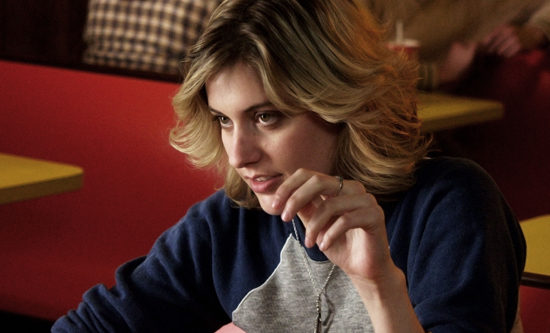
Confession: the reason I watched this in the first place was because of the friend. Yep, it's Greta Gerwig. And, yep, even in a small role in a "traditional" film she brings her natural acting vibe (not to mention some very Farrah hair).
The movie climaxes in a chilling scene of desperation that made me want to turn the lights back on. But then, West tacks on 15 minutes, abandoning his pacing and focus and turning on the blood faucet. It's not really tacked on as the whole movie was leading to this point, but it's too brusque a tone shift. As for the very ending, um, I don't know what he was trying to say (if you want to know what happened, leave a comment and I'll explain). Overall, though, this is a great pick if you're looking for something fresh to watch this Shocktober.
Wednesday, September 22, 2010
Playlist Double Feature
"Mumblecore" like "grunge," was a clever adjective that lost its charm the second time someone used it. It is a somewhat apt description for the crop of low budget indie films that popped up in the early part of last decade, but labels only ever end up forcing mass generalization and often overshadow the work itself. Back to grunge, it got to the point where it only mattered if a band was from Seattle for them to get swept up in the hype wave, not that they even sounded like the bands that came before them or, far less important, if they were even good. Luckily for the art form, if not for the artists, mumblecore has never been adopted by the mainstream. So not only do we still get interesting films that Hollywood would never make, but the filmmakers still get the freedom to make them.
We've talked (a lot) on this site about our admiration for the work of Mark and Jay Duplass, but there are other major players in the close-knit, collaborative scene. I recently watched two films by Joe Swanberg, Hannah Takes the Stairs (2007) and Nights and Weekends (2008). He directed the first and co-directed the second with his co-star, Greta Gerwig. Gerwig is also the stair-taking Hannah and is credited as a co-writer on both films, though almost all the dialogue was improvised. Got all that?
Hannah follows Gerwig's character as she struggles to discover her post-college identity, both personally and professionally. The film opens with her in a seemingly healthy relationship with none other than Mark Duplass (it literally opens with them naked in the shower together). She soon finds herself drifting between co-workers played by Andrew Bujalski (the "Godfather of Mumblecore") and Kent Osborne in what she self-diagnoses as a state of "chronic dissatisfaction." It's a great term and may very well be this generation's emotional legacy.
That is essentially the plot, or at least the sequence of events. It's just people talking, but the lack of action is sufficiently supplemented by the authenticity of the on-screen relationships. I know this could so easily be a pretentious mess and no doubt would be if the actors weren't so uninterested in sounding like actors. The interplay in these movies is the closest I've come to listening to real people talking to each other on film.
Nights and Weekends actually lowers the fi even more with almost the entire film consisting of just Swanberg and Gerwig navigating their long-distance relationship. It's a character study more than a movie, but with an intimacy that's at times both refreshing and heartbreaking. The narrow scope does result in a few slow stretches, maybe a few too many. But, again, for its faults, it's hard not to appreciate what they were trying to accomplish.
Subscribe to:
Posts (Atom)