Showing posts with label mumblecore. Show all posts

Tuesday, November 2, 2010

Mumblecore Wrap Party


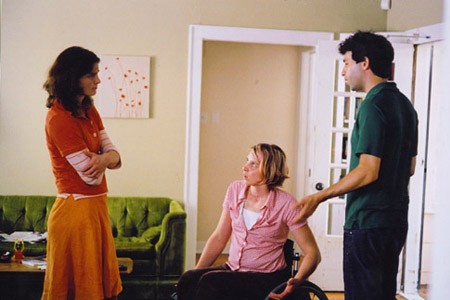
 You know that thin line between keeping it real and really pretentious? Apparently, Joe Swanberg decided to cut that line out of the already low budget for his 2009 film, Alexander the Last. It's about an actress and her sister and her husband and the the guy she's doing a play with and, well, I think that's about it. Relationships? I'll let EW's Owen Gleiberman explain: "...an exploration of how the spaces between people can separate them or join them, often at the same moment." That, folks, is a movie critic.

It's pretty clear that for these small films about people just being people, the people will ultimately determine success. The movies that work for me are the ones featuring charismatic leads--Mark Duplass, Greta Gerwig, even non-actress Kate Dollenmayer. Not everyone in real life is interesting. In fact, most people are not, at least not to others. For the viewer to care about mundane subject matter--the whole point here, right--the characters have to be more than that. They have to be interesting. It's like the old line that you would pay to hear Christopher Walken, Al Pacino, etc. read the phone book. No you wouldn't. At least not past Adams. But you do like them, though, and want to spend time with them. The characters in Alexander? I didn't even want to spend the ridiculously short 72 minutes with them. It's more masturbatory artists making films about artists. Forget about the pretentiousness factor. That sounds more like simple laziness.

There are still some mumblecore films on my playlist. I'd like to see Swanberg's Kissing on the Mouth, and not just because it's dirty. His LOL is supposed to be another genre staple. I've also heard good things about Alex Holdridge's In Search of a Midnight Kiss. But of the ones I have watched, here's how I'd stack them:

  1. Hump Day
  2. The Puffy Chair
  3. Cyrus
  4. Baghead
  5. Hannah Takes the Stairs
  6. Funny Ha Ha
  7. Beeswax
  8. Nights and Weekends
  9. Mutual Appreciation
  10. Alexander the Great
Question for those who saw it: does Greenberg count?

Friday, October 15, 2010

Playlist Triple Feature


The term "mumblecore" was coined by sound mixer Eric Masunaga, but it was his director, Andrew Bujalski, who brought it to life. Though "life" might not be the best word choice for a filmmaker of such purposefully anti-plot movies. Three, to be exact.

The movie usually credited with launching the movement was Bujalski's 2002 debut, Funny Ha Ha. As if you had to guess, it's the story of recent college grad Marnie trying to find her place in adulthood. The movie drifts along with her, its structure bringing to mind Richard Linklater's 1991 Slacker, itself credited with kicking off the indie boom of the previous decade. While I can't deny Slacker's influence--Kevin Smith has said it directly inspired Clerks--I also can't deny that I didn't like it. Honestly, I really disliked it and it has come to symbolize that pseudo-intellectual pretentiousness that made going into an indie video or record store so painful in the early 90s. There was nothing authentic about Slacker's Austin denizens. Everyone spoke in monologues that sounded like excerpts from some stoner's thesis. The appeal of Funny Ha Ha, and the films that have followed it, is the dedication to un-pretentiousness. Or seeming unpretentious at the least. The problem with that approach, however, should be obvious if you have ever had a conversation with actual people: even the most interesting talks aren't interesting the whole time. If you ever read a transcript of yourself conversing you would probably start a blog just so you could flame yourself. It's why top screenwriters get paid so well. Audiences don't want real dialogue, but dialogue that seems real. That's the real movie magic.

I'll stop here to say I enjoyed the film. Kate Dollenmayer was a very watchable Marnie and while I wouldn't say her life was captivating, she held my attention, at least enough. I can see why critics were so taken by this movie when it was released (and the same goes for Slacker). Movies like these work best when they're unexpected. Timing always skews perspective, so it's not hard to imagine how refreshing a no-frills indie would be after yet another TV show remake or Ashton Kutcher masterpiece.


Dollenmayer wasn't an actress and, despite the potential displayed here, has only appeared in one other film. That would be Bujalski's 2005 Mutual Appreciation. As if Funny's 16mm rawness wasn't mumbly enough, Bujalski took it down another notch by going the black and white route with his story of a trio of 20somethings trying to figure out their lives. Indie musician Justin Rice is the lead and the only time the movie shows a pulse is when he performs on stage. The music's pretty good (Rice's Bishop Allen band mate, Christian Rudder was in Funny). I don't know what else to say about the rest of the film other than it was just dull. A concern facing talk-heavy films is that the talking doesn't just have to be good, it has to be better than that in another movie where it's offset by action. Or plot. Or monkeys. Here, I felt like I was watching the stuff that usually gets edited out of films. "Ums" and "ahs" have only so much charm.

(Bujalski co-starred in both of these films, as well as Joe Swanberg's Hannah Takes the Stairs. He's not a bad actor, but he's not very likable. Like that guy who would make you not go to a party on the off chance you might get stuck talking to him for even 30 seconds. You know who I'm talking about.)


Bujalski's greatest strength as a director is showcased in his most recent film, 2008's Beeswax. It stars identical twin newcomers (or rather, no-comers), Tilly and Maggie Hatcher as the latest non-professional actors whose talent he has been able to max out. He gets that people are naturally multidimensional and everyone is a character in someone's story. But again, that doesn't mean that story is necessarily interesting. I would rank this second of the three, closer to positive than negative. The production value is a tad higher and there's even a sampling of tension in the script. Listen, it's something. I know it's important to keep these in context, but after this triple play I wouldn't mind a car chase. Or five.

Wednesday, September 22, 2010

Playlist Double Feature


"Mumblecore" like "grunge," was a clever adjective that lost its charm the second time someone used it. It is a somewhat apt description for the crop of low budget indie films that popped up in the early part of last decade, but labels only ever end up forcing mass generalization and often overshadow the work itself. Back to grunge, it got to the point where it only mattered if a band was from Seattle for them to get swept up in the hype wave, not that they even sounded like the bands that came before them or, far less important, if they were even good. Luckily for the art form, if not for the artists, mumblecore has never been adopted by the mainstream. So not only do we still get interesting films that Hollywood would never make, but the filmmakers still get the freedom to make them.

We've talked (a lot) on this site about our admiration for the work of Mark and Jay Duplass, but there are other major players in the close-knit, collaborative scene. I recently watched two films by Joe Swanberg, Hannah Takes the Stairs (2007) and Nights and Weekends (2008). He directed the first and co-directed the second with his co-star, Greta Gerwig. Gerwig is also the stair-taking Hannah and is credited as a co-writer on both films, though almost all the dialogue was improvised. Got all that?

Hannah follows Gerwig's character as she struggles to discover her post-college identity, both personally and professionally. The film opens with her in a seemingly healthy relationship with none other than Mark Duplass (it literally opens with them naked in the shower together). She soon finds herself drifting between co-workers played by Andrew Bujalski (the "Godfather of Mumblecore") and Kent Osborne in what she self-diagnoses as a state of "chronic dissatisfaction." It's a great term and may very well be this generation's emotional legacy.

That is essentially the plot, or at least the sequence of events. It's just people talking, but the lack of action is sufficiently supplemented by the authenticity of the on-screen relationships. I know this could so easily be a pretentious mess and no doubt would be if the actors weren't so uninterested in sounding like actors. The interplay in these movies is the closest I've come to listening to real people talking to each other on film.

Nights and Weekends actually lowers the fi even more with almost the entire film consisting of just Swanberg and Gerwig navigating their long-distance relationship. It's a character study more than a movie, but with an intimacy that's at times both refreshing and heartbreaking. The narrow scope does result in a few slow stretches, maybe a few too many. But, again, for its faults, it's hard not to appreciate what they were trying to accomplish.